How to say "I don't know" with confidence

🔊 Note: I'm building a masterclass to help more people become exec-ready communicators and scale their influence at work! To get early access: sign up for the waitlist here (no commitment needed).
There's a tricky scenario I see playing out at work every now and then.
It goes something like this:
- You're presenting in a meeting, and get thrown a curveball question.
- You don't have a good answer, and you get rattled a bit.
- You give a half-baked response, but your lack of confidence shows.
- Your audience senses it – so they press on even harder...
- ...and you get rattled even further. And thus the cycle begins.
Now, we can't control people throwing curveball questions at us during meetings.
But here's what we can control:
- Our ability to quickly recognize when a question is a distraction
- Our ability to tactfully address these kinds of questions
- Our ability to stay poised – even if we're essentially saying "I don't know"
And in today's newsletter, we'll talk about how to do this the right way.
👋 Join 5000+ readers and subscribe to Herng's Newsletter for free:
First rule: don't sabotage yourself.
Believe it or not – saying "I don't know" isn't that bad. There's a scenario that's worse.
It's when people get thrown a curveball question and panic – and then instantly resort to a magical phrase:
"That's a great question... we don't have details in the slides, but we can take it offline."
Let me be clear: this is one of those corp-speak phrases that you learn, and then burn from your vocabulary forever.
Why? Because unless you are in a position of power, or unless you have extreme stakeholder trust:
- You are shutting down the conversation. You are not making any attempt to engage.
- You are being passively-aggressive. You are all but implying that the question is unworthy of taking up live meeting time.
- You are being patronizing. And this will backfire especially if your audience is senior.
So when it comes to dealing with curveball questions, what is the alternative to using corp-speak or giving half-baked responses?
Well, it depends on the type of question.
Second-order questions
Many curveball questions are second-order questions. These questions are valid – but they just focus on things that don't quite move the needle.
And that can often be a distraction.
For example, imagine that you're presenting an analysis on why customer churn rates have worsened this year for your business. You hypothesize that it's mainly due to customer support levels being cut.
Here are some examples of first-order questions. They directly help validate (or invalidate) the argument at hand.
- "Did we make any big pricing changes in these markets this year?"
- "Could it be because our competitors came out with discounts?"
- "What were the top reasons cited by unsubscribed customers?"
By contrast, consider these types of questions:
- "Did we account for a longer February this year when calculating the YoY percentage?"
- "There was one day where our systems were down; did you factor that in?"
- "Does your churn metric include involuntary cancellations due to expired credit cards?"
Why do we consider these to be second-order questions?
Well, because regardless of what the answer is, we don't get that much closer towards sharpening our central thesis. And that often just leads to wasted time and effort.
In these situations, here are a few ways I suggest engaging.
You can start by firmly but respectfully pushing back. For example:
- Question: "Did we account for a longer February this year when calculating the YoY percentage?"
- Response: "That's a good flag. We didn't adjust for that, although the churn signal we're seeing is large enough such that this variance shouldn't change things too much."
You can hold your ground, but still leave some wiggle room. For example:
- Question: "There was one day where our systems were down; did you factor that in?"
- Answer: "Given we're seeing a sustained trend throughout the year, we suspect that isn't a factor, but it's a good point – we can add it to the list of things to check."
You can also acknowledge the underlying sentiment behind a rather tactical question and uplevel the conversation.
For example:
- Question: "Does your churn metric include involuntary cancellations due to expired credit cards?"
- Answer: "I'll have to double-check to be sure, but this gets at a great point: we did change our payments policy a few times this year, and we'll look into whether those changes have had a material impact on churn."
Scope-creep questions
Consider again our earlier example. Imagine that we now face these questions:
- "When do we think churn will stabilize?"
- "What part of our customer support was most critical?"
- "Can cheaper pricing offset the impact of less customer support?"
These are all valid questions – yet you most likely won't have answers on the spot. And that's OK.
Because you need to recognize that these questions implicitly demand scope creep.
And you need to find a constructive way to engage.
So, instead of doing this (and coming off as unhelpful):
- ❌ "I'm not sure; we didn't look at that yet."
You can gently establish your boundaries, but do your best to still engage:
- Question: "When do we think churn will stabilize?"
- Answer: "We're not sure at this point, as we've focused first on establishing causation for this past year. That being said, based on the most recent trendlines we're seeing, churn rates don't seem to be deteriorating as fast anymore."
You can proactively communicate your gameplan to show that even if you don't have an answer now, you are thinking ahead:
- Question: "What part of our customer support was most critical?"
- Answer: "At this point we're trying to establish that customer support really is the issue. Once we have enough confidence there, we'll then start an analysis on which parts of customer support to bring back."
You can also just use explicit labels to help people understand what's in scope for now, and what's not:
- Question: "Can cheaper pricing offset the impact of less customer support?"
- Answer: "We're not sure yet, but that's one of the things we'll definitely analyze once we get into the solutioning phase. At this stage, we're trying to get a clean view of internal vs. external factors first, which will help us figure out our focus for the next phase."
Remember: the point isn't to be defensive in order to protect your ego ("I don't know the answer, but you really shouldn't expect me to know either.")
Rather, it's about giving assurance that even if you don't have an answer on the spot, you're still consciously thinking about where it fits into your overall gameplan.
👋 Subscribe for free to get Herng's newsletter directly in your inbox.
Disproportionate-effort questions
The last bucket of curveball questions we'll talk about is often the trickiest.
These questions can be first-order in nature, and fully reasonable to be considered part of your scope.
But they take disproportionate effort to answer – which makes it OK sometimes not to have (or even attempt to have) an answer.
For example, imagine if you got this question:
- Question: "Can we add three extra dimensions to the analysis? I'd like to see if customer support is still a key issue after we control for income level, engagement rates, and location."
Instead of saying the below (and coming off as either inefficient, incompetent, or even self-centered):
- ❌ "I'd love to update the analysis, but that will take quite a while, and I'm not sure we can do it in time..."
Try bringing people along the journey:
- ✅ "That would be quite insightful for sure. My worry is that due to the data availability, we'll probably have to carve out a significant amount of time validating the data to ensure it doesn't lead to misleading outcomes..."
And demonstrating a bit more ownership:
- ✅ "...that being said, we might be able to do some quick-and-dirty estimates by making some assumptions. Perhaps we could do that first and share those results to see if they're helpful? Then we can also decide if we want to go even deeper."
You'll then find yourself not so much pushing back, but rather working together with your audience to determine the best path ahead.
Infinitely better than "Your question makes sense, but we just don't have time to figure out an answer."
Takeaways
If you get curveball questions in a meeting?
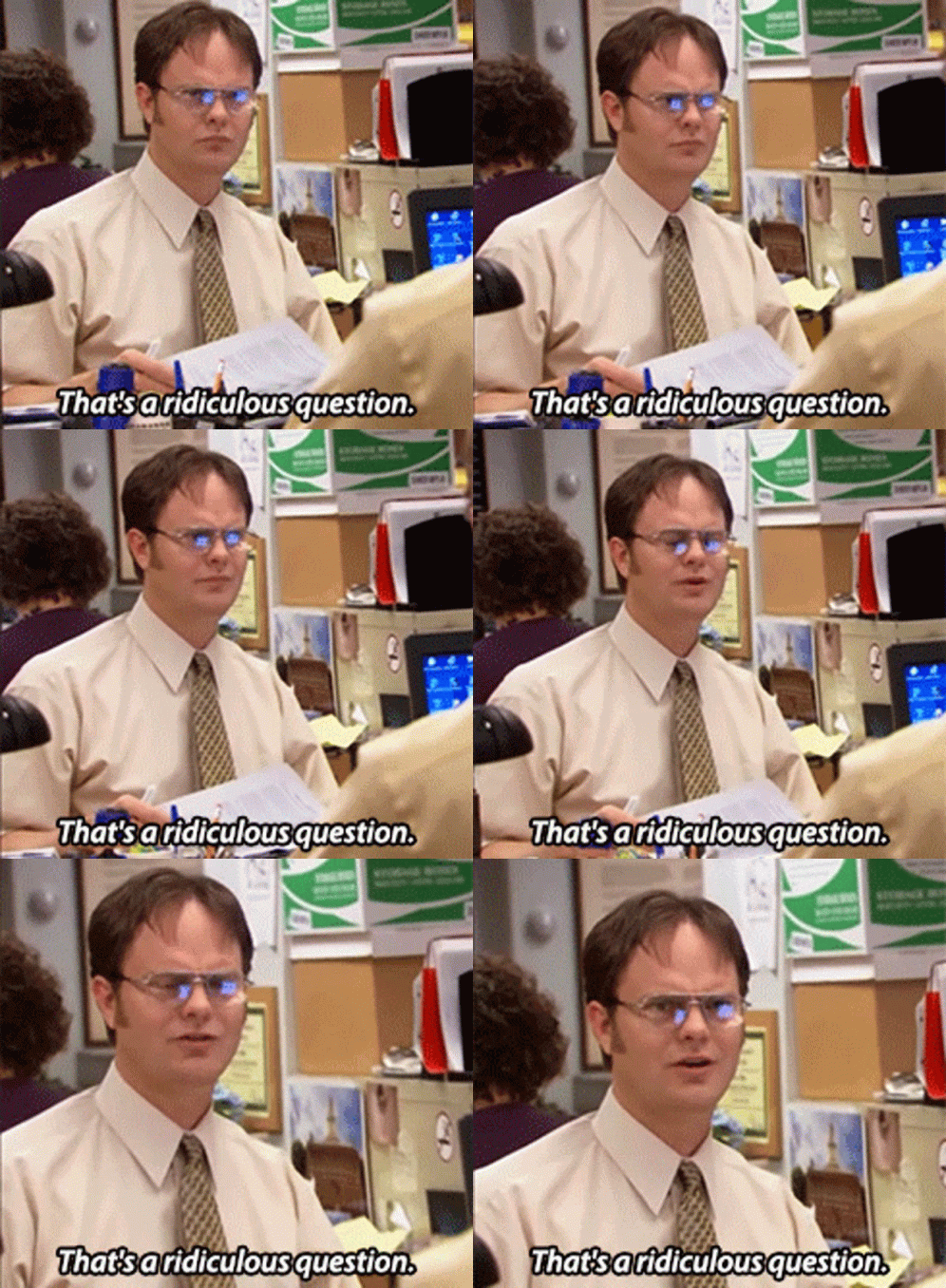
Don't:
- ...simply say "I don't know" (even if justified) and leave your audience hanging
- ...resort to saying "Great question, let's take this offline" as a cop-out
- ...attempt to overpower your audience with long soliloquys
Instead, try to do this:
- Figure out what makes a question a "curveball." Ask yourself whether it's because it's too tactical, borders on scope creep, requires disproportionate effort, etc.
- Acknowledge upfront that you don't have an answer – but also figure out the intention behind the question. Even if the question itself is subpar – the underlying objective might not be. Give it the benefit of the doubt.
- Do what you can in the moment to engage and be helpful (e.g. offer a directional answer or a qualified hypothesis). You can take agency as well by upleveling the question or proposing an alternative angle.
Happy curveball-fielding!
🧠 Thanks for reading Herng's Newsletter this week! If this was forwarded to you, join 5000+ readers and subscribe for free here.
🔊 Reminder: if you found this useful, you might also enjoy the masterclass I'm building! Learn how to influence execs and punch above your weight at work. To enjoy early access: sign up for the waitlist here (no commitment needed).


